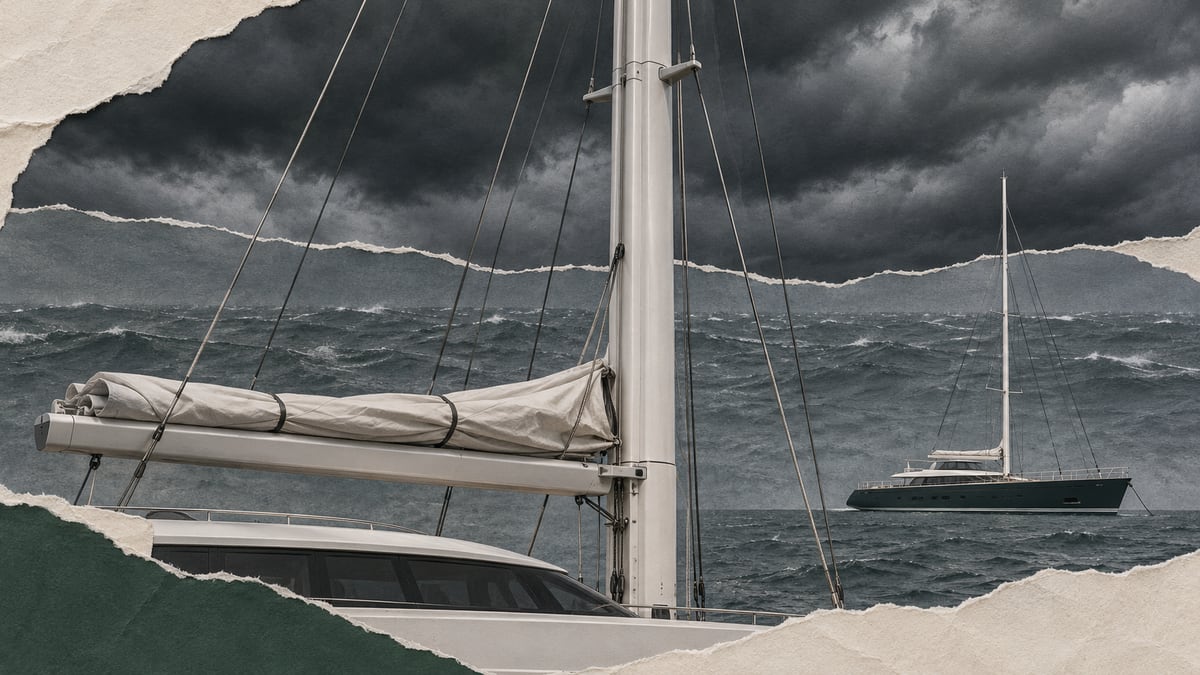
The crew of the Bayesian superyacht were unaware of a critical safety risk that left the vessel dangerously exposed to powerful winds before it sank off Sicily on 19 August 2024, killing seven people, the Marine Accident Investigation Branch has reported.
British tech entrepreneur Mike Lynch, 59, and his daughter Hannah, 18, were among the dead when the 56-metre yacht went down off the Sicilian coast. UK inquest proceedings are examining their deaths and those of Morgan Stanley International chairman Jonathan Bloomer, 70, and his wife Judy Bloomer, 71, all of whom held British nationality. Mr Lynch and his daughter are understood to have lived in the London area; the Bloomers were based in Sevenoaks, Kent. Fifteen survivors, including Mr Lynch's wife Angela Bacares, were pulled to safety.
The MAIB launched its investigation because the Bayesian was UK-registered. Its final report says winds of approximately 80mph struck the yacht, which capsized in under 15 seconds, was forced beyond the angle from which it could right itself, and sank 18 minutes later. Flooding did not cause the initial capsize; water became a significant problem only after the yacht was already on its side.
Investigators found the yacht's susceptibility to powerful winds had never been assessed for the conditions in which it was anchored, with sails down and its retractable centreboard raised. The centreboard is a large underwater structure that helps keep a sailing vessel stable. Because that risk had never been evaluated, the crew did not know how readily the yacht could capsize, the report states. Principal inspector Simon Graves said Bayesian had a vulnerability that, from the design stage onwards, there was no requirement to assess, so it had not been identified.
The yacht was anchored off the fishing village of Porticello on the night of 18 August 2024 with 12 guests and 10 crew. The captain had told those on watch to wake him if winds exceeded 20 knots, roughly 23mph, or if the anchor dragged. At 3am the wind was calm, though lightning and storm clouds were closing in. At 3.44am a crew member on watch posted a video of the approaching storm. Eleven minutes later winds were about 35mph. The captain was woken around 4am and the crew began preparing the engines to move. At 4.06am the wind suddenly rose to around 80mph. The yacht was thrown onto its side, sending people and furniture across the decks.
Investigators believe the weather was most likely a downburst, a powerful blast of air from a thunderstorm that hits the sea and spreads with great force. Lead investigator David Robertson said the forecast did not mention the chance of violent winds, crew training had not covered it, and guidance did not cover it, which limited the crew's ability to recognise the hazard and act in time. Mr Graves said forecasts that day indicated generally reasonable weather with a possibility of thunderstorms, but none described what was actually experienced. He said the crew were overtaken by the speed of the knockdown and had very little time to react. Once the vessel was knocked down, they set off the emergency beacon, released a life raft, and got some guests into it.
Five people were injured either by falling or by things falling on them, and the deckhand was thrown into the sea, the report says. Two guests used furniture drawers as an improvised ladder to leave their cabin. The skipper told guests and crew on part of the deck to swim clear of the mast and boom as the vessel sank. Survivors reached a life raft released from the Bayesian and were rescued by a small boat from the yacht Sir Robert Baden Powell, anchored nearby. None of the Bayesian's life rafts floated free and inflated automatically; crew had to release a raft by hand. The captain and another crew member swam back to try to release another raft, without success. Alcohol played no part, the report concluded.
Chief inspector of marine accidents Rob Loder said the vulnerability to high winds was not recognised because the yacht had never been assessed at anchor with its sails down, and the extreme winds were not explicitly forecast. The MAIB has published a safety flyer and recommendations on design standards, crew training and how rare but severe weather is shown in forecasts. He urged regulators, training providers and weather services to act on the report. The Maritime and Coastguard Agency has also opened its own investigation.
The British findings appear to differ from recent Italian prosecution experts, who have reportedly attributed the tragedy to crew errors rather than faults with the yacht. Mr Graves said the two inquiries are separate and can reasonably reach different conclusions because their aims differ. The MAIB's role is to prevent future accidents, not to assign criminal blame. The report notes that Italian prosecutors restricted access to some witnesses and evidence, and that the account may change if that material is disclosed. Mr Graves said the branch is content with the investigation it carried out.
In Italy, captain James Cutfield, chief engineer Tim Parker Eaton and deckhand Matthew Griffith face potential charges of multiple manslaughter and culpable shipwreck.
Separately, survivors Charlotte Golunski and James Emslie, who escaped with their young daughter, have said in High Court filings that the catastrophe resulted from serious safety failings in the yacht's design and in the crew's conduct. They are challenging an attempt by two companies linked to the yacht to limit compensation. Their barrister, Matthew Chapman KC, said the companies knew or were likely to have known that continuing to operate the yacht in the forecast and experienced weather exposed passengers to a probability of death or injury, and still allowed it to be operated. He argued they acted recklessly with actual knowledge that defects in design, construction and operation would probably result in loss of life, personal injury and consequential losses. The family claim passengers were left to scramble to safety on their own with very limited assistance from the captain and crew.