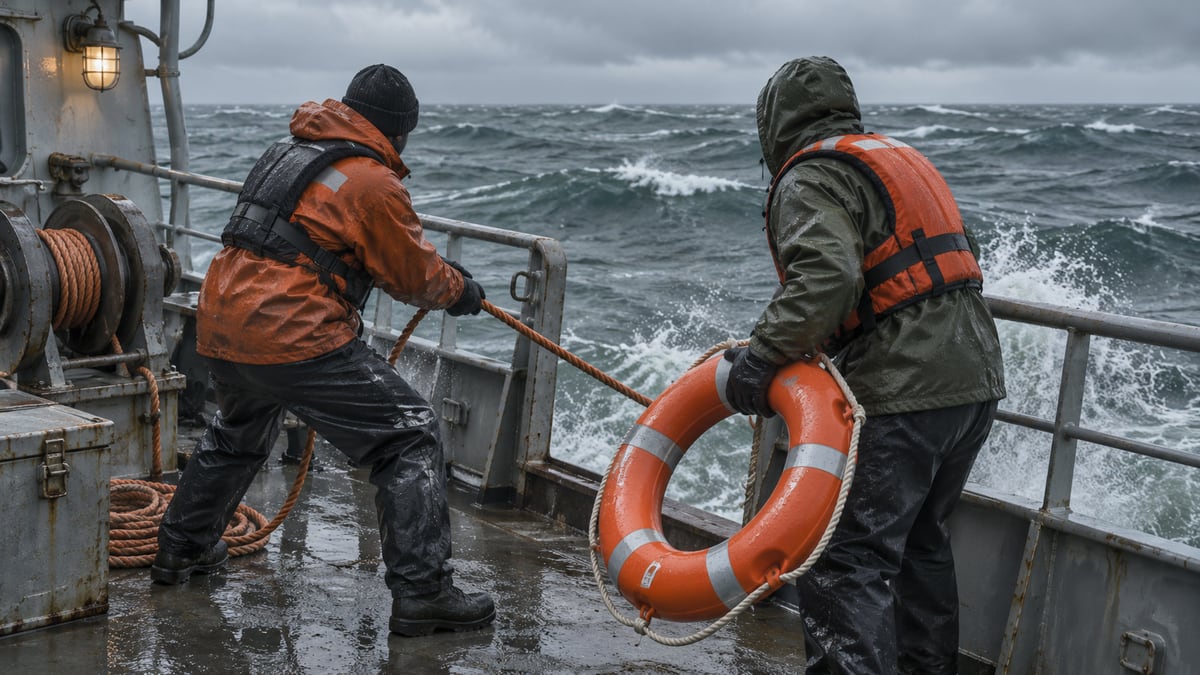
Just after 1am on 13 October, Commander Ivan Ivanov and his crew received a mayday from the Malta-flagged Chelsea 3, sinking in the Black Sea about 40 kilometres from the Bulgarian port of Varna. A drone had blown a large hole in the ship's side and it was taking on water.
Ivanov, who has worked at sea for 20 years, told the ABC the weather was extremely bad, the sea stormy, the wind very strong and visibility very low. The Chelsea 3 was the first sinking cargo ship in distress he had dealt with. When his crew arrived the ship was listing hard to the left, and the choppy seas made it too dangerous to launch a lifeboat. The sailors jumped from the sinking ship onto the border-patrol vessel. All of them were saved.
As the crew returned to port, a second mayday reported that another cargo ship, the Guinea-Bissau-flagged HS Dignity, was sinking after being hit by multiple drones. Worsening weather made a further rescue too dangerous. Five of the crew were saved after abandoning ship in a lifeboat. Eleven remain missing.
The HS Dignity had been travelling from Algeria to Romania. Among the missing is Amjad, the 20-year-old cousin of Mohammed Mreish. Mreish told the ABC last month that he felt they were alive and still had hope, and that Amjad's mother would not have closure until her son was found. He travelled from his home in Germany to Varna and spoke with rescued sailors. He said they woke in the middle of the night, found the ship full of water and ran to the deck to launch the lifeboat. They saw what they thought were two vessels approaching quickly and believed a rescue was coming; they were sea drones. Amjad was one of 14 Syrians in the crew.
Commander Bozhidar Penev, who has spent more than a decade with Bulgaria's border police, was also on call that night. He told the ABC the last few weeks had been tough, that surveillance had been increased further, and that crews stayed on high alert with multiple systems for day and night. He said drones had made the work more dangerous, that he was afraid of them and that the possibility was always there, but that the task still had to be done. The ABC embedded with the border police, who act as the country's coast guard on search-and-rescue missions.
Merchant ships carrying grain, chemicals and oil have increasingly been caught in the crossfire of Russia's war in Ukraine. Both countries have Black Sea ports and have been striking ships going to and from each other's docks since Moscow's full-scale invasion. At least 38 sailors have been killed since June, and more than 500 ships have been hit in the waterway in the past year. The ABC reports that strikes have shifted from trying to disable ships toward hitting hulls and bridges in an attempt to sink them, a tactic known as a double tap.
During October, nine cargo ships were hit by drones inside the exclusive economic zones of Bulgaria and Romania, and one strike was inside Romania's territorial waters. Ships are sailing closer to shore because wartime insurance premiums have risen sharply and the coastal route is seen as carrying fewer risks. Tomas Alexa of the maritime security agency Ambrey said he expected the attacks to continue, that Russia was testing the response and unity of NATO's eastern flank and of the European Union, and that further attacks in Romanian-Bulgarian waters were likely because, in his words, the glass was broken.
Bulgaria's former defence minister Todor Tagarev, in office when Russia launched its full-scale invasion, said the Kremlin's main aim was to crush Kyiv's economy by cutting off sea trade, while also testing how far NATO countries would go to protect one another. He said one centre of gravity for Ukraine was European support, and that by showing how dangerous the situation was becoming for European countries and societies, Moscow hoped that support would diminish. He said historical ties with Russia were holding Bulgaria back from a stronger response, and that Bulgarian officials were afraid to refer to Russia as an aggressor or to plan on that basis.
Romania, Bulgaria and Turkey are NATO members on the Black Sea, with Turkey controlling access through the Bosphorus. NATO's Article 5, under which an attack on one member is treated as an attack on all, has been invoked only once before, after the 11 September attacks in New York. The alliance was formed after the Second World War by the United States, Canada, the United Kingdom and many European nations, and it has sent more patrol planes, radar systems and intelligence officers to the Black Sea.
Professor Kevin Rowlands of the Royal United Services Institute, who spent three decades in the British Navy and retired as a captain, said it was politically easier to go to war for the United States in 2001 than it would be against Russia. He said some NATO allies were more closely aligned with Russia than others, so any such declaration would be highly political. He said an attack was an attack and that, if two countries were at war, it should be called a war. Analysts believe Moscow is likely to keep hitting ships that support Kyiv's economy while the front line in Ukraine remains largely at a standstill.